You've probably heard that you need to be using email marketing to grow your business. But what is email marketing, exactly? And is it really worth adding one more thing to your never-ending to-do list?
I hate to be the bearer of bad news, but yes. If you have a business and you’re trying to grow it (or even maintain it), email marketing is a crucial component.
That’s because email marketing is one of the best ways to build relationships with your audience, promote your offers, and turn casual followers into paying customers. And unlike social media, you don't have to cross your fingers and hope the algorithm decides to show your content to the right people.
Whether you're a coach, content creator, or small business owner, I'll break down what email marketing is, how it works, and how to get started without making it your entire personality.
What Is Email Marketing?
First things first, email marketing is a type of digital marketing that involves sending emails to a list of subscribers to build relationships, share valuable content, promote products or services, and ultimately grow your business.
Sounds pretty simple, right? But one of the most common mistakes I see people making is sending nothing but promotional emails left and right. Don’t do that!
Good email marketing isn't about constantly selling. It's about building relationships and compounding trust.
Think about your own inbox for a second.
You probably have a handful of brands or creators whose emails you actually look forward to opening. Maybe they share helpful tips, make you laugh, or send you exclusive offers you can't resist.
And then there are the brands that send nothing but sales pitches. You know, the ones that make you hit unsubscribe faster than you can say "50% OFF!"
The difference is that one is focused on building a relationship, while the other is focused on making a sale.
Don't get me wrong. The goal of email marketing is absolutely to generate revenue. We're running businesses here, not charities.
But the best way to make sales is to give people a reason to open your emails in the first place.
How Does Email Marketing Work?
Email marketing works by collecting email addresses from people who want to hear from your business and sending them relevant content through an email marketing platform.
Here's what that typically looks like:
Someone joins your email list. They might subscribe through your website, download a free resource, or sign up for exclusive updates.
They receive a welcome email. This introduces them to your brand and delivers any freebies you promised.
You continue sending emails. These might include educational newsletters, personal stories, business updates, or promotional offers.
You build a relationship. Over time, subscribers get to know you, understand what you offer, and become more likely to buy.
Of course, not every subscriber will become a customer. And that's okay!
Email subscribers can provide value in sooooo many ways (like being your biggest fan, referring you to other clients, etc.). The goal is to consistently show up for the right people so that when they're ready to buy, your business is the one they think of.
Benefits of Email Marketing
If you're already posting on Instagram, creating content, and trying to keep up with approximately 47 different marketing trends, you might be wondering why you need email marketing, too.
Fair question!
Here's why I think email deserves a permanent spot in your marketing strategy.
1. You Have More Control Over Your Audience
Your email list is an audience you can reach without relying on a social media algorithm. Social media is great for building brand awareness and attracting new followers, but you don't control who sees your content.
One day, your Instagram Reel gets thousands of views. The next, you're lucky if your own mother sees it. And don’t even get me started on how long it takes to create content!
With email marketing, you can communicate directly with subscribers who have already expressed interest in hearing from you. Of course, email deliverability matters, and there's no guarantee every message will land in someone's primary inbox.
Still, having a permission-based email list gives you more control over how and when you communicate with your audience. And the people who sign up to hear from you are telling you they want to hear (or read) what you have to say!
2. Email Marketing Helps Build Trust
People are generally more comfortable buying from businesses they know and trust, and email marketing gives you the opportunity to build that trust over time.
You can share your expertise, tell personal stories, answer common questions, and help subscribers solve problems before they ever spend a dollar with you.
For example, if you're a fitness coach, you might send weekly emails with workout tips, nutrition advice, or encouragement for people struggling to stay consistent.
Over time, your subscribers start to see you as someone who understands their challenges and can help them reach their goals. Then, when they're ready to hire a coach, guess who's already on their radar? Hint: It’s you.
3. You Can Generate More Sales
While building relationships is great, we also want those relationships to turn into revenue.
Email marketing allows you to promote your products, services, launches, and special offers directly to people who have already shown interest in your business. And you don't have to be pushy about it!
You can incorporate calls to action into your regular newsletters, create dedicated sales campaigns, or use automated email sequences to introduce subscribers to your offers.
The key is balancing promotional content with emails that educate, entertain, or otherwise provide value.
4. It's Cost-Effective
Compared to many other marketing channels, email marketing can be relatively inexpensive.
Most email marketing platforms offer plans based on your subscriber count, sending volume, or the features you need. And unlike paid advertising, you don't necessarily have to spend more money every time you want to reach your audience.
That doesn't mean email marketing is free. You'll still need to invest in an email platform, content creation, and potentially someone to manage your strategy.
But a well-maintained email list can become an incredibly valuable business asset that helps generate far more than it costs.
5. You Can Automate Your Marketing
I love a marketing strategy that doesn't require you to be glued to your laptop 24/7. With email automation, you can create emails that are automatically sent when someone takes a specific action.
For example, when someone downloads your freebie, you can trigger a welcome email series that introduces your brand, shares helpful resources, and encourages them to take the next step.
You write the emails once, set up the automation, and let the sequence do its thing. That means you're building relationships with potential customers even when you're not actively working!
Types of Email Marketing
Not all marketing emails serve the same purpose. Some are designed to educate, others are meant to sell, and some are simply there to remind your subscribers that you exist.
Here are a few of the most common types of email marketing:
1. Email Newsletters
Email newsletters are recurring emails sent to subscribers, usually on a weekly, biweekly, or monthly basis. They might include educational content, industry insights, personal updates, business news, or a combination of everything.
As a newsletter writer, I'm a big fan of newsletters because they give you a consistent way to stay connected with your audience. And they don't have to be complicated!
A great newsletter can be as simple as a personal story, a helpful takeaway, and a relevant call to action.
2. Welcome Email Sequences
A welcome email sequence is a series of automated emails sent to new subscribers after they join your list. The goal is to introduce yourself, establish trust, and help readers understand how your business can help them.
Think of it as the digital equivalent of introducing yourself at a party. Except you have a little more time to think about what you're going to say.
I typically recommend a welcome series of one to five emails, depending on your business, audience, and goals.
3. Promotional Emails
Promotional emails are exactly what they sound like: emails designed to promote something.
This might include a new product, a limited-time discount, an upcoming event, or an invitation to book your services. And yes, you should absolutely be selling to your email list!
Just make sure every email isn't one giant sales pitch. Give your subscribers a reason to stick around between promotions.
4. Nurture Email Sequences
Nurture sequences are automated emails designed to build relationships with subscribers over time. Unlike a welcome sequence, which typically focuses on introducing your brand, nurture emails can go deeper into your audience's problems, questions, and objections.
For example, a business coach might create a nurture sequence that shares productivity tips, addresses common business challenges, and introduces their coaching program.
The goal is to help subscribers understand the value of your offer before asking them to buy.
5. Sales and Launch Sequences
Planning to launch a new product, course, membership, or service? A sales email sequence can help build anticipation, explain the benefits of your offer, address objections, and encourage readers to take action.
These campaigns are usually sent over a specific period and have a clear goal, like generating purchases or booking discovery calls. And no, sending one email announcing your launch and hoping for the best doesn't count as a strategy!
6. Re-Engagement Emails
Sometimes subscribers stop opening your emails. It happens.
A re-engagement campaign is designed to reconnect with inactive subscribers and determine whether they still want to hear from you.
You might share a particularly helpful resource, ask readers to update their preferences, or simply check in. If someone still isn't interested, it's okay to let them go.
A smaller list of engaged subscribers is more valuable than a massive list of people who couldn't care less about your emails.
Email Marketing Best Practices
Now that you know what email marketing is and the different types of campaigns you can send, let's talk about how to do it well. Because having an email list and having an effective email marketing strategy are two very different things.
Here are my top tips to build an engaged email list that actually buys.
1. Know Who You're Talking To
Before writing a single email, you need to understand your audience.
Who are they? What do they struggle with? What do they want? And how can your business help? The more you understand your subscribers, the easier it becomes to write emails they actually want to read.
For example, a nutrition coach working with busy moms probably shouldn't be sending the same emails as a strength coach working with competitive athletes. Even if both businesses operate in the fitness industry, their audiences have different goals, challenges, and interests.
Your emails should reflect that!
2. Write Like a Human
Please, for the love of all things marketing, stop writing emails that sound like corporate press releases. Your subscribers are people. So, talk to them like people!
Use contractions.
Drop a curse word.
Tell stories.
Show some personality.
And don't be afraid to have an opinion!
You don't need to sound professional in the traditional sense to establish authority. In fact, I would argue that being relatable and authentic is one of the best ways to stand out in an increasingly crowded inbox.
Read your emails out loud before you hit send. If you wouldn’t say it, don’t type it. Don’t overthink it!
3. Send Emails Consistently
You don't have to send an email every single day to be successful, but you should be showing up consistently. For most small businesses, I recommend starting with one newsletter per week or every other week.
The most important thing is to choose a schedule you can realistically maintain and stick to it.
4. Make Your Emails Easy to Read
Nobody wants to open an email and find one giant wall of text, especially when they're reading on their phone.
Keep your paragraphs short, use clear formatting, and make it easy for subscribers to skim your content.
And don't feel like you need to use a fancy email template! A simple, text-based email is typically all you need. Focus on good copy, and the rest will come.
5. Include a Clear Call to Action
Every email should have a purpose. Before you start writing, ask yourself what you want readers to do after opening it.
Do you want them to read a blog post? Reply to your email? Book a consultation? Buy a product? Whatever your goal, make the next step obvious.
That doesn't mean every email needs a hard sales pitch. Sometimes your call to action can be as simple as asking subscribers to hit reply and share their thoughts or having them click a link. We just want there to be some kind of action at the end!
6. Pay Attention to Your Analytics
Your email marketing platform should provide data about how your campaigns perform.
Some of the most useful metrics include:
Open rate: The percentage of delivered emails recorded as opened. Keep in mind that privacy features can make this number less reliable.
Click-through rate: The percentage of delivered emails that generate at least one tracked click.
Conversion rate: The percentage of recipients or visitors who complete a desired action, depending on how you're measuring it.
Unsubscribe rate: The percentage of recipients who unsubscribe after receiving an email.
Revenue: The sales or other business value generated by your campaigns.
Don't obsess over every little statistic. Instead, look for trends over time and use what you learn to improve your content.
7. Follow Email Marketing Laws and Guidelines
I know. Not the most exciting part of email marketing, but it's important!
In the United States, commercial emails are subject to the CAN-SPAM Act, which includes requirements for accurate sender information, non-deceptive subject lines, and a clear way to unsubscribe.
Other laws, including GDPR and Canada's CASL, may apply depending on your subscribers and business.
You should also follow your email service provider's permission and consent requirements.
And while we're talking about the technical stuff, make sure your domain authentication is properly configured.
Google has published email sender guidelines covering authentication, spam rates, and other practices that help emails reach inboxes.
Tips for Building Your Email Marketing List
You can't send emails if you don't have anyone to send them to! The good news is that you don't need thousands of subscribers to get started. You just need a way to attract the right people and give them a reason to join your list. Here are the tips I give my clients:
1. Create a Valuable Freebie
One of my favorite ways to grow an email list is through a lead magnet, also known as an email freebie.
This is a free resource you offer in exchange for someone's email address and permission to send them marketing emails. It might be a checklist, template, guide, mini-course, or something else your audience finds useful.
For example, a fitness coach could offer a free workout plan, while a business coach might create a guide to planning a productive workweek. One of my freebies is my Clickworthy Copy Bank, a collection of hooks and calls to action you can use in your emails.
The key is creating something that solves a specific problem for your ideal customer. Your freebie should attract people who are genuinely interested in what your business offers.
2. Add Signup Forms to Your Website
Make it easy for people to join your list! You can add email signup forms to your homepage, blog posts, website footer, or dedicated landing pages.
You might also use a pop-up to promote your freebie. Just make sure your forms clearly explain what subscribers are signing up for.
3. Promote Your Email List on Social Media
Your social media followers are already interested in your content. So, why not invite them to take the relationship a step further?
Share your lead magnet in Instagram Stories, add a signup link to your bio, or create posts explaining why people should subscribe. And give them a reason!
"Join my newsletter" isn't nearly as compelling as "Get my weekly tips for building strength without spending hours in the gym." Tell people what's in it for them.
4. Use Your Blog to Attract Subscribers
If you're already publishing SEO-optimized blog posts, you're sitting on a great opportunity to grow your email list. People discover your content through search engines because they're looking for answers to specific questions.
If your blog post solves their problem, you can invite them to subscribe for more helpful resources. Better yet, offer a relevant freebie that builds on the topic they're already reading about.
5. Focus on Quality Over Quantity
I'll say it again for the people in the back. You do not need a massive email list to make money with email marketing!
A list of 500 subscribers who are genuinely interested in your business can be more valuable than 10,000 people who never open your emails. Focus on attracting subscribers who are likely to benefit from your content, products, or services.
Email Marketing FAQs
-
If you're completely new to email marketing, I recommend keeping things simple.
First, choose an email marketing platform. Popular options include Flodesk, Kit, and Mailchimp.
Each offers different features, pricing, and automation capabilities, so choose the one that makes the most sense for your business.
Next, create a signup form and give people a reason to join your list. Once subscribers start rolling in, set up a welcome email sequence to introduce yourself and explain what they can expect.
Finally, choose a realistic newsletter schedule and start sending emails.
You can always get more sophisticated with segmentation, automation, and sales funnels later. For now, focus on getting started and showing up consistently.
-
Very! Your subject line is one of the first things subscribers see when your email lands in their inbox. It helps them decide whether your email is worth opening or whether they'll keep scrolling.
A good subject line should spark curiosity, communicate value, or give readers a reason to pay attention. But that doesn't mean you need to resort to clickbait.
In fact, misleading subject lines can damage trust and violate email marketing rules. I recommend keeping your subject lines clear, interesting, and relevant to the actual email content. And don't forget about your preview text!
-
Email marketing campaigns help you stay connected with your audience, build trust, promote your offers, and encourage subscribers to take action.
Depending on your goals, you might use email marketing to generate sales, book more clients, drive traffic to your website, or increase customer retention. And unlike social media content, which can disappear from someone's feed almost immediately, your emails give subscribers a direct way to engage with your business.
The biggest benefit, in my opinion, is that email marketing helps turn an audience into a community of people who actually care about what you have to say. When you build that kind of relationship, selling becomes a whole lot easier.
Ready to put email marketing to work?
By now, you know what email marketing is, why it matters, and how to get started. But knowing you should be sending emails and actually finding the time to write them are two very different things.
If writing newsletters keeps getting pushed to the bottom of your to-do list, I can help!
At Open Inbox Studio, I help business owners and personal brands turn their ideas into engaging emails that build relationships, establish authority, and support sales.
Whether you need consistent newsletters or a strategic email sequence, I'll help you create emails your subscribers actually want to open. Check out my newsletter writing services to learn how we can work together.
Looking for more? You may also like:



Hey I’m Shyanne!
The email copywriter & LinkedIn writer behind Open Inbox Studio.
I combine storytelling and marketing tactics to help create connection, build trust, and generate sales…all without requiring you to show up on socials.
Thanks for Reading!
Curious about how I can help with your email marketing? Read more about my email writing services and how they can help you build the audience (and income) of your dreams!
Whether you’re looking to build connection, drive sales, or a little of both, I’m here to help with weekly emails and strategic funnels to take email marketing off your plate!
Email Writing Services
LinkedIn doesn’t have to be boring! I’ll help you share your expertise, build authority, and stay top of mind with the people who matter to your business with personality-based posts that actually drive connection.
LinkedIn Writing Services

Hey, I’m Shyanne!
The Writer Behind Open Inbox Studio
I combine storytelling and smart marketing strategies to help brands and creators build connection, earn trust, and generate sales through email and LinkedIn.
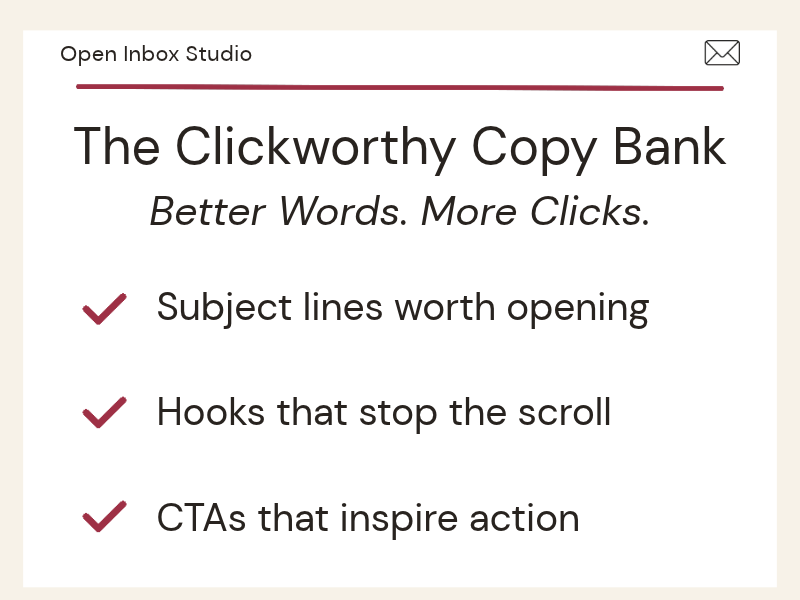
Steal My Clickworthy Copy Bank!
Your shortcut to writing emails and content that get noticed, opened, and clicked.